
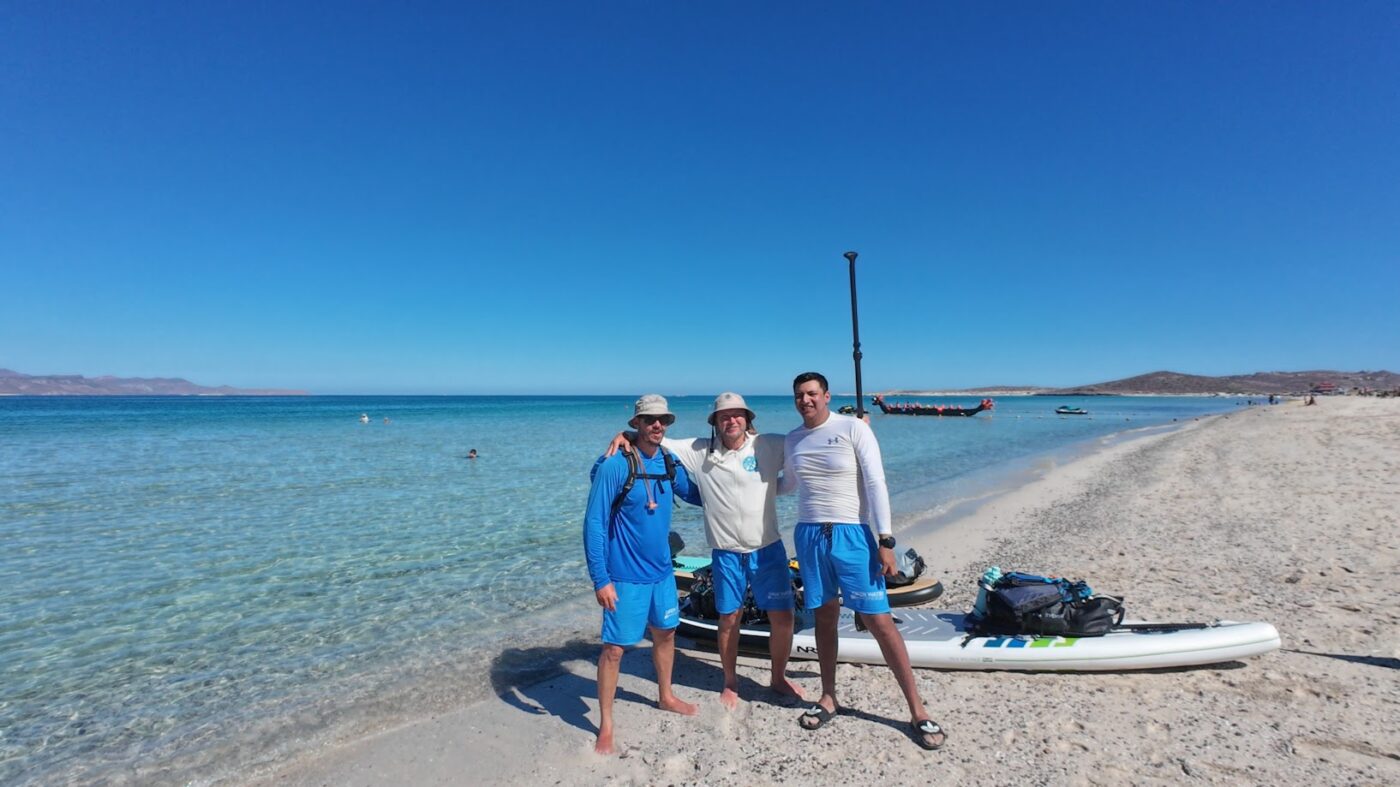
OPEN WATER SYNDICATE — EXPEDITION LOG
(Stand-Up Paddleboarding Around Isla Espíritu Santo & Isla Partida, BCS, Mexico)
DAY 1 — THE BEGINNING
Every expedition starts long before the first paddle stroke. Ours began in the same place all our ideas are born — somewhere between stubbornness, curiosity, and that itch to see what’s on the other side of the map. The idea lived in my head for a while, but an idea means nothing without the right people beside you. And somehow, one by one, the team formed. People who said yes when most would have said, you’re crazy. People who understood that real adventures start exactly where comfort ends.
We weren’t rookies. We’d crossed Lake Ontario three times. We knew what it was like to paddle for hours without seeing shore, to battle headwinds and side winds, to fight the moment when your body wants to quit but your brain says, keep going. But this expedition… this one felt different. For the first time, we were stepping into real open ocean — no city lights behind us, no safety boat beside us, no shortcuts.
So we prepared the only way we know how: properly. Boards, gear, food, water, portable desalination unit. Every piece checked twice. And mentally… well, the hardest part of any expedition is simply saying yes. Once you commit, the rest follows.
Windy App showed strong winds on Day Two — especially on the west side of Isla Espíritu Santo. Our emergency contact, Niko, warned that waves could reach a meter. Not ideal, but that’s the nature of adventure: if everything was predictable, it wouldn’t be worth doing.
We arrived in Cabo, settled into Casa Velas, and turned the house into a gear-testing lab. Pumps, fins, valves, dry bags — everywhere. At 3 a.m., our new friend Alex pulled up, half-asleep but smiling. We loaded the boards, tied down the bags, and just like that… we were rolling into the unknown.
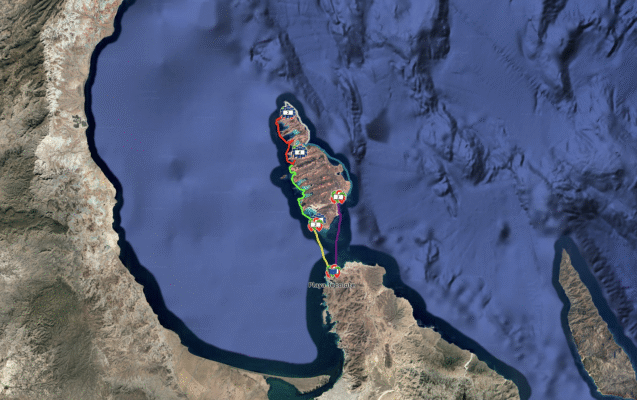
THE FIRST CROSSING
It was almost a three-hour ride to Playa Tecolote. We arrived at dawn — soft light, calm water, that quiet feeling right before something big starts. A light breeze pushed north toward the island. Good sign.
We inflated the boards, loaded our provisions, tightened every strap, checked every clip. One last handshake with Alex, one last breath of stable ground… and then the first paddle stroke. One of thousands to come.
The route showed 8–9 km to our first stop, Playa Bonanza. Simple on paper. But paper never tells the whole story.
My Garmin tracked the numbers — distance, heading, speed — but instinct handled the rest. Lake Ontario had taught me to read water by eye, and something inside me said we were good. It felt right. Like all my past crossings were pieces that led to this one moment.
We passed the channel between the mainland and island, and the water came alive — fish, shadows, flashes under the boards. Then we turned the first cape, and suddenly the west side of Espíritu Santo revealed itself: long, clean, untouched. A 5 km sweep of sand and turquoise.
Playa Bonanza. Clear water, no noise, no people. Just us and this massive desert island rising behind the beach.
We dropped in for a quick dive — cold water shock, perfect visibility, and more marine life than we expected. A few jellyfish, but nothing the rashguards couldn’t handle.
But then came the wind.
It started slow, then picked up like someone turned a dial. Gusts reached 20 km/h. No waves thanks to the cove, but the resistance was real.
Armando and I rode pointy touring boards — the “dictator line,” as I always joke: pointy is scary — while Dave carried half the kitchen on a round board. Heavy load, wrong shape, and gusts hitting the bow… that combination creates its own adventure.
It took over an hour to reach the northern part of the beach. Just sand, desert, and silence. Then I saw it — a single tree standing alone like a king of the emptiness. A small patch of shade in a place where shade is gold. That was our camp.
ARRIVAL TO CAMP — BONANZA
We unloaded the boards, moved everything under the tree, and finally took a breath. Dave boiled water, opened the dehydrated meals, and honestly — that meal tasted better than most restaurant dinners. That’s the magic of real hunger.
On the far north side of the beach, another group was camped — identical three-minute tents, older beachgoers sunning themselves. They didn’t seem thrilled to see us. Turned away, avoided eye contact, like we’d asked for handouts. But in a place like this, money means nothing. Water is the only real currency — and even that only matters if shared from a good heart.
We weren’t there to take anything. We had enough water. Enough food. Enough experience.
We explored the rest of the shoreline, then returned to our tree — our little oasis. To avoid the nightly symphony of snoring, we set our tents with respectful distance between them. The sun dropped fast behind the ridges, painting the mountains in gold. That Baja sunset is something you don’t forget: warm air, quiet beach, boards resting on sand… everything finally slowing down.
We smoked our first cigar of the trip, shared stories, made jokes, and agreed to wake up at 5:15 a.m. for an early start.
That night, I had one of the most vivid dreams of my life — lying in my tent, looking out at the sand, a huge tiger walked right past me. Calm, powerful, unreal. Maybe my mind was processing the wildness around us. Maybe it was just a dream. Either way, it stayed with me.
DAY TWO — INTO THE DEEP
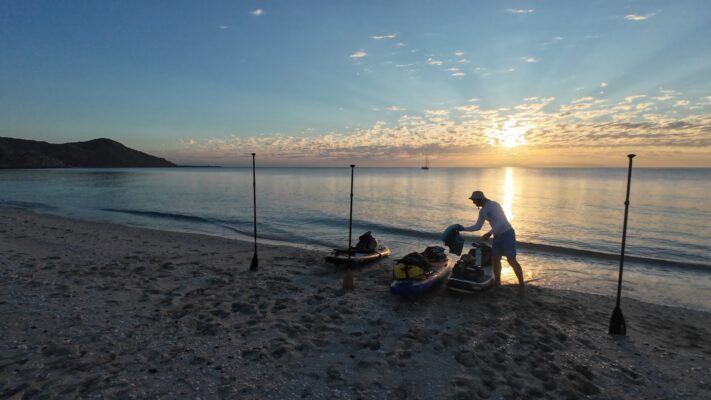
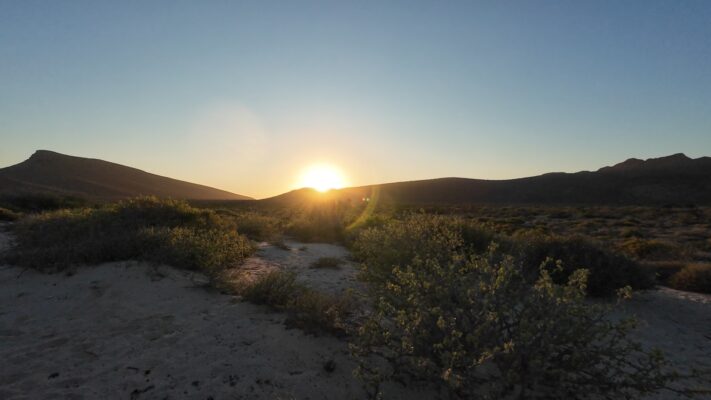
The alarm went off while the world was still asleep. That thin early-morning darkness where the mountains are just silhouettes — sharp, silent, waiting for the sun to paint them alive. Dave handed me a sip of instant coffee — the sacred morning ritual of any expedition — and we began breaking down camp. Packing the boards, checking every strap and dry bag, making sure we left nothing behind. Leave No Trace wasn’t just a rule; it felt like a promise we owed to the island.
Before leaving Toronto, I had studied the charts again and again. Today we were heading into deep territory — the kind of depth that makes your mind wander. Six hundred meters below. A whole silent world we would never see. The sea, however, was calm, glassy almost, and that alone felt like a blessing.
The beauty of an expedition like this is simple: you never truly know what waits around the next cape. Behind those enormous rocky walls, anything could appear — wind, current, calm, chaos, or some hidden new shade of ocean you’ve never seen before. But something inside me kept repeating: The island accepted us. She will show everything she wants to show.
And so we paddled. Cape after cape. The cliffs rose above us like ancient temples carved by a patient god. The water changed shades as we moved — dark sapphire, then electric blue, then almost purple where depth swallowed the sun.
We had to try it. We had to feel it.
So we jumped in. Straight into six hundred meters of pure blue. A vertical infinity under our feet. The water hugged us with cold honesty. Fish swam around us, unafraid and curious, like we were just part of their morning routine. No fishing here. No predators. Just balance. Perfect, quiet harmony.
Garmin said 3 km to Playa Partida.
We paddled on, and then the moment came — rounding a corner, we saw the two islands split by that narrow passage. Ahead, a rocky beach appeared, uneven and littered with medium-sized stones. From afar, it looked like trouble — the kind of landing where you might have to climb or carry boards over sharp rock.
Dave asked, “Are we gonna have to portage this?”
“Let’s pass the rocks on the left,” I said.
And just like that, everything opened. No big obstacle, no drama. A clean spit between the rocks revealed a long sandy stretch — maybe five hundred meters of pale, untouched beach. Soft dunes behind it. A little lagoon of still water glowing like a mirror. And a small fisherman’s shed standing there quietly, like it was waiting for us.
We approached it.
“Do you have ceviche?” I asked the fisherman.
“Not yet,” he said. “We go to sea at night. By two a.m. we’re back.”
We continued to the far north corner and landed there. Boards on the sand. First steps on Playa Partida. A new chapter beginning.
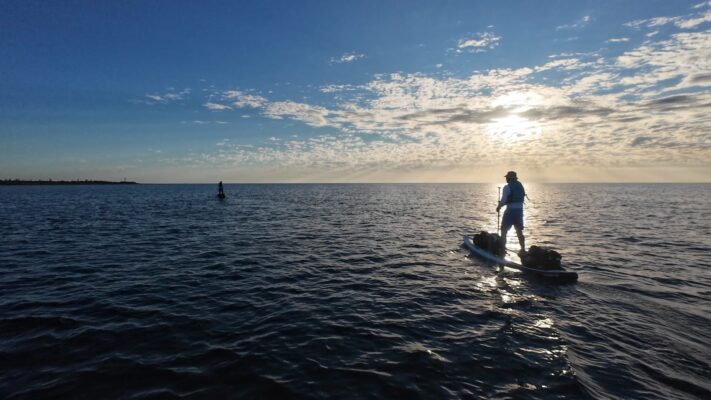
DAY 2 — AFTERNOON AT PLAYA PARTIDA
Our Day Two campsite was on the northern side of Playa Partida. We unpacked our gear and immediately jumped into the crystal-clear water. The instant refreshment felt unreal. Small jellyfish drifted around, but the rashguards did their job.
Swimming along the side of Isla Partida, we found small rock formations that created miniature cities for fish. I spotted a small moray eel. Everything here was curious, not fearful — as if fear didn’t exist in these waters.
Then I noticed a rock formation react to my presence. It closed like a gate.
A massive oyster.
Was it edible? Maybe. Maybe not. But out here, there were no warning signs. Using the handle of my Insta360, I detached one carefully.
“Guys, look what I got! Who wants to try an oyster?”
Dave was in.
Armando — not a seafood guy — was not.
We hunted only what we could eat. Pure wild nutrition.
Armando had bought a fancy oyster knife the night before. He tried opening one — and cut himself on the shell.
“Let me try,” I said.
A small rock, a gentle tap, a slice through the main muscle — it opened beautifully.
We rinsed them in the ocean, squeezed lime, and ate.
The freshest oysters of my life — from one of the most unpolluted places on Earth.
The sun was brutal, so Dave built an OWS-style shade using our boards. A perfect breezy shelter.
Baja sunsets come early. Around 5:30 p.m., the sun dipped behind the mountains, turning the sky gold. We set up our tents, smoked our evening cigar, and recorded a timelapse of the glowing horizon.
Night fell fast. The Milky Way lit up the sky like a painting.
We walked toward the fishermen’s shed — soft sand, cool air. A moray eel came close to shore, reacting to our lights, when suddenly a fast fish struck it. Nature’s rawness, right in front of us.
Back at camp, we discussed the next leg.
Armando favored the east side based on wind reports.
I felt the west was better.
Dave agreed.
No conflict — just teamwork.
Two young rabbits hopped by, curious, calm. No food offered.
We set the alarms for 5:15 a.m.
Sleep didn’t come easily — not fear, just thoughts. The island still had much to show.
DAY THREE — LA PLAYA EMBUDO
Day Three began as always — early morning, before sunrise. We were still on the west side of Isla Partida, facing the open deep water. With a first sip of instant coffee and gear assembled, we were ready to depart.
The water was glassy — nothing like Windy App had predicted. No strong winds, just a calm, peaceful morning that made the early wake-up worth it.
We moved forward, shifting formations as we paddled. Turn after turn, the island revealed its ancient architecture, shaped by millions of years of wind and waves. Tall cliffs, caves, layered rocks — raw, untouched, timeless.
From time to time, we jumped into the deep blue. What rose above the surface was only the tip of an ancient underwater mountain plunging into infinite depth below, teeming with marine life we could only imagine.
Rounding one corner, we spotted a small rocky islet about 500 meters ahead — home to one of the largest sea lion colonies in the area. Seeing them in their natural habitat was a primary goal of our expedition, so we headed toward it.
As we approached, guided boats were tied to designated buoys. One had just dropped off a small group. We asked permission to tie our boards to a buoy and join the guide to observe the colony respectfully. Permission granted.
We geared up and slipped into the water. The wind was fresh but manageable. A massive male sea lion lay on the rocks — we kept our distance, respecting their space.
Exploring further, we discovered a deep, dark cave carved into the rock. Inside, young sea lions swam in perfect harmony — playful, curious, moving like underwater puppies. They darted and spun around us, completely at ease. It was an unforgettable, magical moment.
After spending time with them, we thanked the boat captain and continued toward our next campsite: Playa Embudo.
A few more turns, and the cove revealed itself — calm, protected on both sides by steep vertical cliffs. A secluded, pristine beach appeared ahead, soft sand meeting impossibly clear water that felt unreal.
We landed on our Day Three campsite: Playa Embudo.
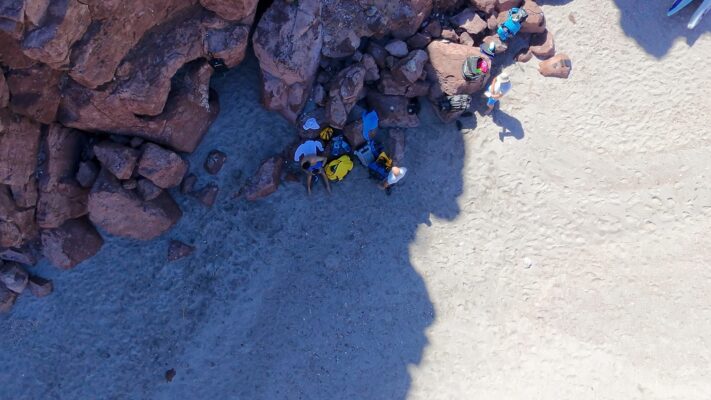
PLAYA EMBUDO — EVENING
Playa Embudo was completely secluded — hidden from the direct sun and offering one of the most breathtaking views a mortal person can experience. There was no need for a sunshade here. We set up our tents right away, letting the warm afternoon sun dry out the moisture accumulated from the previous campsite.
Once the tents were up, we had lunch. Dry food had never tasted so good. Credit to MEC (Mountain Equipment Co-op) for selling such a delicious variety.
We filmed our daily video update — showing the campsite, the new galley, and the ancient cave formation next to us. Its sandy floor and natural wind-carved “cabinetry” on the ceiling were stunning.
“This place would make an excellent shelter during heavy winds or rain,” Dave remarked.
Then it was time to snorkel.
The deeper water here held a rich, diverse marine habitat. Larger fish moved calmly around us, going about their daily lives but curious about the alien species — us. I found another oyster and ate it. The energy from that fresh, wild creature felt more authentic and fulfilling than any dry meal.
A small boat appeared on the horizon, and a group of tourists landed for lunch. We greeted them, and after a brief chat with the tour operator, each of us was given a can of cold juice. Really cold. On a hot, desert-like beach, it tasted unreal. Soon they left, and the beach returned to being completely ours.
Time passed, and golden sunset light filled the space between the rocky mountains. Earlier, I had noticed a cave formation on the left side of the mountain — about a 3–4 meter climb. In the fading light, we decided to check it out. We climbed up and entered what we jokingly called the “ocean-view one-bedroom and den” cave. The view was stunning.
Back on the beach, we noticed pieces of wood — remnants of a previous fire attempt. Though everything looked dry, the fire hadn’t taken. I dug a small hole in the sand and tried again with tiny twigs, but it went out. Then I found some dried, leaf-like flowers on the beach. They lit beautifully, though the fire still wouldn’t sustain. Dave went scouting in the dark and returned with more dried flowers. Using the smallest branches we could find, we tried once more.
Success.
A beautiful fire came to life on that secluded beach under a warm November night sky in Baja, the Milky Way shining overhead. Of course, we enjoyed our traditional cigar.
“This is the best campground so far,” Dave said.
During the day’s snorkeling, we hadn’t seen any moray eels, so I decided to go for a night swim. Dave joined me. The water was calm and mysterious — a whole different world after sunset.
Tomorrow we would reach the end of Isla Partida and begin the east side of Isla Espíritu Santo. We decided to wake up without alarms — whenever our bodies naturally allowed.
We went to sleep, ready for the next day’s adventure to reveal itself.
To be continued…
Day 4 — Toward Playa Candelero
A new day began. We woke up later than usual, packed our gear, cleaned the beach, and made sure nothing was left behind. Then we pushed off. The wind had picked up stronger than usual — a steady headwind. Not dangerous, but enough to make us work for every meter.
According to the pirate map, the next inlet had a freshwater well. Since we were running low, we decided to check it out. I had only 1.5 liters left. We did have a desalination device, but our earlier attempts proved how difficult it was to operate. A natural freshwater source was our best hope.
We arrived at a short, shallow beach squeezed between two rocky mountains. Taking the water bag, we followed a narrow pass that led inland. Less than a kilometer in, Armando spotted a human-made well. He and Dave ran ahead — and by the looks on their faces, I knew it was bad news.
The well was about 20 feet deep. There was water at the bottom, but a terrible smell drifted out. Something had died inside — an animal or a bird — leaving the water unusable.
We still had 8–10 kilometers to reach our next campsite, Playa Candelero. The pirate map showed another freshwater well ahead, so I said out loud, “Maybe we’ll get lucky with the next one.”
We left the inlet slightly disappointed.
Moving forward along giant cliffs, we approached the narrow passage that separates Isla Partida from Isla Espíritu Santo. As we crossed, I turned back one last time.
“Hasta la vista, Isla Partida,” I said quietly. “I hope to see you again.”
Ahead of us, Isla Espíritu Santo rose with towering walls of layered rock — ancient timelines carved into stone. Then a beautiful natural arch appeared. I remembered Alex telling me:
“When you see the arch, go under it and make a wish.”
So I did. I wished for peace within myself. Armando passed through next, then Dave.
The headwind held steady around 15 km/h. On our right, a small rocky islet appeared — another sea lion colony. We kept our distance, but strong side waves threw Armando off his board. His long leash tangled around the fin, and the constant chop made it hard to climb back on.
The sea lions noticed.
A squad of mature males — no playful pups this time — launched toward him like a patrol unit, surfacing and disappearing with precision.
“Armando, get on your board! Quick!” we shouted as the distance closed.
With one strong attempt, he pulled himself up. The sea lions barked loudly, announcing their dominance and telling us, very clearly, to move on.
They weren’t wrong. We were only visitors.
Suddenly the wind died — like someone flipped a switch. The water turned glassy. In the distance, I saw a fin sticking out of the surface. It didn’t move.
It was a lone sea lion floating on his back, one flipper raised toward the sky. Away from his colony. Completely calm. No fear of orcas or anything else. Just existing — in perfect harmony.
I approached slowly and slipped into the water. He noticed me and began moving with absolute grace — dancing like an angel, weightless, effortless, unbothered. I was speechless. When he finished, he simply drifted away, back into the blue.
We took the next turn — and Playa Candelero came into view.
Dozens of beautiful yachts were anchored: sailing boats, luxury motor yachts, the works. We decided to ask for fresh water (and Dave began mentally manifesting an ice-cold cerveza).
We paddled toward the largest, most elegant yacht — Sea Shell 2. A group of kayakers was just arriving, and the crew helped them aboard. We waited, then approached.
“We’re running low on water,” we asked. “Could you spare some?”
The owner, Henry — a kind middle-aged man living the good life on his yacht — didn’t hesitate. He instructed his crew to fill all our reservoirs. Dave asked, half-jokingly, for a cold cerveza.
Wish granted. Three ice-cold beers appeared.
God bless you, Henry — and your family.
We thanked the crew, then paddled to Playa Candelero’s beautiful sandy shore.
Our Day Four campsite.
To be continued…
Playa Candelero — Evening
Warm November sun, soft sandy shore, and turquoise water so clear it looked unreal — Playa Candelero felt like a small piece of paradise after a long day of paddling.
We set up our campsite using Dave’s sunshade tarp, arranged the boards in a perimeter, and covered the sun-facing side with a long microfiber board towel. With plenty of fresh water thanks to Henry, we ate our meals, hydrated properly, set up our tents, and then headed out for a snorkel.
The sunlight reflected off the sea floor, creating beautiful shifting patterns. We swam toward the small rocky island near the beach and began exploring around it. Coral formations created entire underwater “cities,” and fish moved calmly around us, completely at home in this vibrant world. It truly felt like the “world aquarium” Jacques Cousteau once described here.
Time didn’t matter.
These were the moments you store on your mental hard drive forever.
As sunset approached, we returned to camp and set our cameras to capture the evening light — this time the sun dropping directly behind the sea horizon, filling the sky with bright yellow glow.
Darkness arrived.
We smoked our evening cigar.
Then, with red light on our headlamps to avoid attracting mosquitoes, we started exploring. Playa Candelero is actually two beaches split by a rocky wall. We walked past the lagoon — Armando checked the water just in case, but it was salty, connected only during high tide. Small fish lived inside, waiting for the sea to return.
We reached the rock wall and discovered a narrow passage — the kind you can pass through only if you’re lean enough for adventure. We squeezed through the first chamber, then into another, and eventually emerged on the second beach. After a short look around, we returned to our side.
Along the way, a Cacomixtle Norteño appeared — a northern ringtail — curious, calm, fearless. He walked close, studying us the way we studied him. Finding nothing interesting, he slipped back into the night.
Soon after, we went to sleep.
Tomorrow’s destination: our final campsite — Playa Dispensa.
To be continued…
